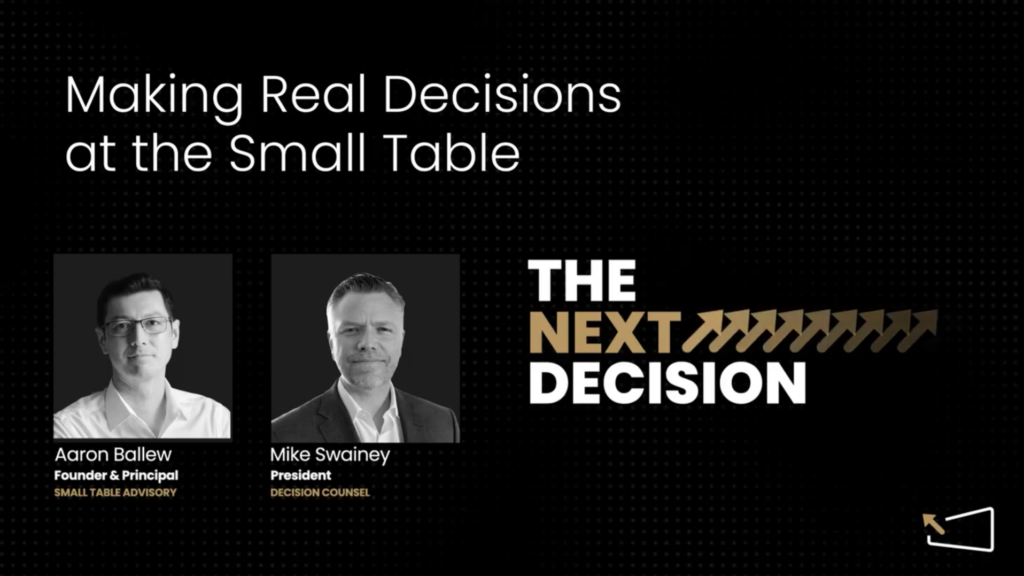
From The Next Decision Podcast: A Conversation with Aaron Ballew, Founder of Small Table Advisory.
The real decisions don’t get made in the all-hands. They get made at a small table, in a small room, by people who aren’t quite sure yet.
In this episode, Mike Swainey talks with Aaron Ballew — the Founder of Small Table Advisory, and a 2x CMO with a background that runs from electrical engineering PhD to telecom to startup and PE-backed marketing leadership.
Aaron’s thesis: the real decisions in any company get made at a “small table” — a handful of trusted people willing to sit with uncertainty before conviction is required in public. The conversation moves from there into a sharper question facing every marketing and GTM leader right now: what does AI actually change about how we decide, and what does it leave untouched?
The throughline across all three: AI is genuinely changing the volume and speed of inputs available to leadership teams. It is not changing the fact that judgment, candor, and human intuition are what turn those inputs into a decision worth making.
The following transcript has been edited for clarity and length.
MIKE SWAINEY 00:00:09.840 – 00:01:42.270
Welcome to The Next Decision, the show about the choices revenue leaders make when the market shifts, growth gets challenging, and the old playbooks don’t work quite as well as they used to. I’m Mike Sweeney, President at Decision Counsel. Today I’m joined by my friend Aaron Ballew, founder of Small Table Advisory.
And if there were actually a world’s-most-interesting-man, Aaron, I think it might be you. You’re an electrical engineering PhD, a two-time CMO. You’ve worked across startups and private equity portfolio companies, in and out of telecom — just sort of the gamut. But today, what I’m super interested in talking with you about, as we kind of reconnect, is your latest adventure with Small Table Advisory. As you and I were talking before the show, when we prepped, you described it as kind of a closed-door session for leaders — a place where they can confront some of the real issues that don’t always get surfaced in public meetings, coming at it from a place of experience and empathy. I love how you phrase that.
So we’ll talk a little bit about AI and the cult-like behavior that sometimes follows it, and then the risk of AI pulling everybody into the mediocre middle. I think that really tees up nicely what it is that you’re doing, and what I’m excited to talk about today — having those conversations in the back room, sometimes at the small table.
So, Aaron, welcome to The Next Decision. It is great to see you today, my friend.
AARON BALLEW 00:01:43.070 – 00:01:45.470
Thanks, Mike. Great to be here.
MIKE SWAINEY 00:01:46.070 – 00:02:03.130
So talk a little bit about how you got to Small Table Advisory. I know the story, but folks listening might not understand your experience — from PhD through CMO, a couple of exits. Talk about how you got to Small Table Advisory and what you’re doing today.
AARON BALLEW 00:02:04.330 – 00:05:13.050
Yeah, sure. I lived a corporate life and did it what I thought was the right way — you work your way up, you get promoted, you take opportunities when opportunity knocks. And I had a wonderful experience working my way up from less than an engineer one — I was an associate engineer — to, more recently, chief marketing officer.
At some point in my life, my grandma had told me there’s nothing like eating an apple off your own tree, and I had never actually done that — I’d only ever gotten a W-2 from these corporations. I decided to try something on my own, and it gives me the ability to scope my work to the things I think I’m actually good at and really enjoy, and none of the other parts. That’s how I got to Small Table.
You asked about some of the really early-stage stuff, like the PhD and all that — it’s true, I was an aspiring engineer and teacher. I thought I’d go into academia. Life is funny that way — who knows what your life is going to be when you’re seventeen and you’re signing up for a thing called a major? I happened to be decent at math, and that’s the positive feedback loop — if you’re decent at math, you take more math, and that happened. But like everybody, there are a lot of things that interest and inspire me: art, music, comedy, culture, working on cars. It’s not all computer science and electrical engineering, although I love that too. I do love math — it’s very beautiful, it’s intriguing.
At some point in my engineering career — I think I was managing a small team of engineers for fourteen years at the time — I had an opportunity to take the technical side and translate the technical gizmos into why anyone should care. Having been sort of on the teaching track, I had a little bit of comfort with the idea of trying to translate things in a way that would be more meaningful to people. So that turned into a technical marketing role, and it kind of continued from there. Marketing was a great pivot for me.
It’s an interesting profession that, as an engineer, I didn’t really appreciate from the outside — I called it marketing fluff, thought it was the arts-and-crafts department. But once I was inside, I realized, wow, there are actually a lot of professions in here. There’s a small finance department in here, there’s a small information-systems department, there’s obviously the creative side, and there’s also a lot of very strategic project orchestration going on. So there are so many professions within marketing — it’s given me a lot to learn from, a lot to grow from.
And now, doing my own thing and trying to help people make sense of that — particularly people outside of marketing, a lot of CEOs who are self-described founders, engineers, product people. They’ll say, “I’m not a marketer.” And that’s great — that’s a great opportunity for me to help fill in that gap.
MIKE SWAINEY 00:05:13.970 – 00:06:20.080
Yeah, I’ve heard that a lot from folks who have backgrounds dissimilar from what we might consider the traditional marketing path. And what’s so interesting about what you’re doing now at Small Table Advisory is that phrase — “the small table” — I feel like it’s doing a lot of heavy lifting, and doing it in a really good way. I promise we’re not going to go full “Inside Man” here, which, by the way, is a fantastic flick if you haven’t seen it yet — but understanding that small table, the room behind the room where the decisions actually get made, and that’s where honest discussions happen.
It’s interesting that even in today’s day and age, that’s still a big part of how decisions and promotions and futures and contracts get decided. So talk to me a little bit about the small table — what does that mean to you, and why do so many really important decisions still happen in those closed-door, conversational moments? Sometimes they happen organically, and sometimes they’re planned.
AARON BALLEW 00:06:20.560 – 00:07:34.420
Yeah, I’d probably take it even further than saying it’s a big part of it — I think it’s really where all the real decisions are made. And maybe there’s some looseness in the phrase “real decisions” — there are definitely decisions that get made elsewhere, too. But I think it’s like — the bigger the audience, the less tolerance there is for risk. There are a lot of questions for which you’re not sure what the answer is, right? And when you’re a C-level executive or a prominent VP or leader, you’re trying to balance a lot of priorities, not just trying to make the decision.
You’re also trying to keep the team motivated, keep them believing — they don’t want to see you faltering, or at least you think you don’t want them to see you faltering. Honestly, if you ask real people who work within your team, they may actually appreciate seeing imperfection, openness, and vulnerability — but that’s a separate issue.
So many leaders try to maintain this projection of certainty and conviction, because they’ve seen what happens when people spin, and they’re worried: if the boss doesn’t know what to do, then I sure don’t know what to do — maybe I shouldn’t be here, maybe I should clean up my resume.
MIKE SWAINEY 00:07:34.540 – 00:07:43.660
And is that kind of why they need that place to maybe say what no one will say aloud? Or is it more the vulnerability piece?
AARON BALLEW 00:07:44.580 – 00:10:01.580
Yeah, they have to have an opportunity to wrestle with ideas for which they don’t know the answer. By the time you get to the all-hands, the decisions are pretty much made and you’re cascading them — you’re saying, “We’ve decided to do this, we’re launching this product, and it’s going to be live by November 1st, and it’s a huge opportunity, and we’re all excited.” But how did that announcement actually come to pass? Well, there was a small table — a small number of people in a small room, or on a small Zoom bridge — wrestling with the possibilities. Should we stay committed to Feature A or Product A that got us here, or should we enter this adjacent category, this new product?
Anytime there are trade-offs to be made — things that don’t feel good, things you wish you didn’t have to say no to — that’s when you have to move it to this smaller, safer forum. Because when you go out in public, most leaders feel they need to be more certain, they have to project stability. But that’s not what’s really happening behind the scenes. To get to that point, it’s very unstable. There are trade-offs. If we go into Feature B, we might not win — we may not have the pedigree, the skills, the resources, the time. We may be late, and if we try it, we may sacrifice development on Feature A, the thing that got us here. Sales is depending on it, customers are asking for it, and we have to trade that off. That’s a scary thing. Or we say, “Let’s redouble our commitment to Feature A, to the focus that got us here” — but we’re going to miss the window for Feature B, and people start asking, “Hey, where’s your new exciting thing? When are you going to say something about that?”
Those are scary conversations. CEOs and CFOs and all those people are human beings, right — they’re all of us, just a few years older, maybe — and they get into that room and they’re wrestling with uncertainty. You might have to be able to say, “Well, I don’t know yet.” It’s a very different tenor than when you get to the staff meeting or the all-hands, where you’re projecting confidence: “This is the right way to go, I believe this is what we should do.”
MIKE SWAINEY 00:10:02.420 – 00:10:54.480
Yeah, I like that, because it gets to that human truth — that they’re human beings too, with fears and aspirations and goals and pressures, and that doesn’t always come to the forefront. I think a lot of leaders recognize that, but they might not always say it out loud. Having that space, being able to be candid, having that moment of private truth, I think is super important — where the official meeting, the all-hands, is where the decision gets presented, but the decision was probably made at a smaller table.
So thinking about that — what did you learn in your career trajectory, in particular as a revenue leader, a growth leader, even as a CMO, about the difference between that public alignment and that private moment, that private truth?
AARON BALLEW 00:10:56.360 – 00:11:32.400
Well, there are certain things — we just kind of riffed on the idea of Product A versus Product B — but these behind-the-scenes conversations are sometimes about people, right? Just take it to the most sensitive possible place. The reason it’s called Small Table is, I actually had a CEO once who hired me and said, “Hey, if I hire you — and in this case, you’re going to be the first C-level employee we’ve had other than myself — I’ve got a great team of leaders, they help me around the business, they’re smart. But you are going to be invited to the small table, where some really hard —”
AARON BALLEW 00:11:33.520 – 00:12:29.510
— strategy conversations happen. Things that affect a lot of people. Talent is an example. When I say talent, it kind of conjures up ideas of maybe a manager or an HR person talking about performance — and yes, that happens, but that’s not what I’m actually talking about. Real conversations that happen at the C level might be the CEO and another executive talking about a third person who’s not in the room, and they say, “This person is great, but I’m not sure they’re the right person for us going forward. It’s not that they’re bad at their job, but they have a certain mix of skills that got us here, and they don’t have the right mix of skills to get us there — so we might need to contemplate changing that person out.” That is an incredibly sensitive kind of conversation that only happens at the small table, and even a subset of that table.
MIKE SWAINEY 00:12:31.150 – 00:13:00.580
And that’s interesting, because now I think you’re beginning to answer what I’m wondering: what makes somebody useful at that small table — is it conviction, or courage, or expertise, or the ability to say something hard that a leader would understand or respond to? If you had somebody invited to the small table for the first time, what advice would you give them to make themselves indispensable in that moment?
AARON BALLEW 00:13:00.900 – 00:14:08.119
Yeah, well, it’s definitely not conviction — in fact, conviction is really the opposite. That’s when you go on stage, you should present conviction. I’ve even gotten that advice before, from leaders, going into a board meeting — because of my personality, I was very much the engineer-techie guy who’d say, “Well, it’s more complicated than that, you have to consider this and consider that.” And some of the advice I got afterward was: everyone understands it’s more complicated than that, but in that meeting, you have to project conviction. I’m not sure that’s perfect in all situations, but that’s more the tone and tenor of being on stage, of presenting your point of view. People are certainly smart enough to appreciate there’s a little bit of nuance here and there, but it’s not a lot of nuance — having that certainty is really important.
So the small-table environment goes in the other direction on the spectrum — a smaller environment, with very chosen counterparts. It’s a safer environment to have less conviction, to tolerate more risk. That’s where the dangerous ideas should be surfaced.
MIKE SWAINEY 00:14:10.880 – 00:16:20.930
Before we move on to the next section — which I think we can dig into now, on AI — I wanted to just note for the record: when we think about AI, we think about all the things it can do, and it’s certainly true that AI can help us in our decision-making by flooding either the large table or the small table with more options, more content, more stuff. But because AI can do all of that, and it helps provide leaders with more input to make their decisions, I wonder if now there’s more noise — and whether the small table becomes even more critical, because having more options, more output, more stuff doesn’t always lead to better judgment. That’s where the small table really comes in.
I talked about this a bit before the show — you and I both agree we’re AI adopters and optimists, but I don’t think either of us would sign up to be AI cultists, willingly handing over the most important decisions to the AI overlords. And if you’re listening, overlords — I love you, I respect you, please think of me well when you take over the world.
But this conversation could get pretty binary — either AI is going to solve everything, or AI is going to ruin everything — and my sense is that’s too simple a way of looking at this. I do feel, though, that AI is creating a sea of sameness, maybe more so than we used to talk about as creative leaders, where it pulls everybody toward the safe middle, which is honestly what AI is kind of set up to do.
So you’ve described yourself as an AI optimist but not a cultist — what does that distinction mean to you? And as leaders think about the breadth of information now at their fingertips, how does that distinction impact the conversations at the small table?
AARON BALLEW 00:16:21.330 – 00:19:34.410
Well, okay, there’s a lot in there — that’s a great series of questions. Let me start with AI. First of all, I’m an enthusiast — I use it every day. I have an agent that automates tasks and workflows; it’s very powerful. I’ve created an agent for my kids to use that helps with homework. That’s Claude Code — a Claude coworker running on a different system. It’s been really valuable, especially as a business owner — I built my website’s infrastructure with it.
When you don’t understand a thing very well, there’s sort of a curve of understanding where your confidence in how well you understand it can be quite high. This is common — you start to bleed into what I’d vaguely call futurism. It’s almost science fiction; you’re imagining all the things it could be, and it’s very inspiring, very energizing. I feel that too. Then — go do it. Actually, fingers on keyboard, not just opening a tab in Claude or ChatGPT, but installing a desktop client — Codex, or a coworker, or try Claude Code, whatever the tool is — the one you’d like to try but haven’t actually tried beyond using it as a search engine. Try to create some workflows. Try to delegate a task to it. Just try it. And if you actually try, you’ll have already jumped across the major milestone between the 80% of AI users and the 20% — you’ll be in the top 20%. Most people are using it as a fabulous search engine and a sort of text-and-thought synthesis engine, where you talk to it, it responds in real time, directly to your prompt. Very few people are actually delegating work to it and using agentic AI, if you’ll forgive the term of art — very few people are doing that. It seems like everybody is, if you look at LinkedIn, but they’re not — it’s very rare.
Part of my daily work, beyond go-to-market advisory, is career coaching, and a lot of people going into interviews feel like an AI imposter. They know AI questions are going to come up, and they’re basically bluffing their way through, because they’ve used Claude or ChatGPT or Gemini as basically a great search engine. But the questions being asked at these tech companies aren’t really about that — they’re looking for agentic experience. Have you actually set up a CLAUDE.md, or an agents.md, in Claude Code or an open agent framework? Once you actually do it and force yourself to not become an incredible engineer — I mean, obviously software developers, it’s quick and easy for them, they’ve got GitHub, they’ve got APIs, they understand tokens — for a lot of people, we just don’t. But once you try it, it’s not such a labyrinth. You build this intuition about tokens and APIs and OAuth, or —
AARON BALLEW 00:19:35.730 – 00:21:12.420
— popping open a browser window to share your login, the different ways to get access to things, which also means the different obstacles to overcome to make things happen. And when you don’t actually try to do it, you get the luxury of futurism — you assume there’s a solution, but you don’t have to live through actually achieving it.
I think crossing that milestone — if anybody would just install it, give it access to your laptop within reason, within the boundaries of your company’s security guardrails, and just try to delegate any task to an AI — you will feel so enriched by that. You’ll feel so much more confident, even though you’re not a mega power user, not in the top one percent, but you’ll be in the top 20%, and you’ll be able to go into that conversation — whether it’s interviews or at work — and you’ll sound like you know what you’re talking about, because you actually do.
There are so many aspects of life where you can instantly tell when someone is having the same conversation, or when they’re kind of an imposter. And the reason a lot of people feel like an imposter is because you’re a rational person correctly identifying a bit of a gap. That’s intimidating, but it’s actually not as big a leap as you fear. It sounds really sophisticated — AI this, AI that — but all these companies, all the “overlords” as you call them, are actually doing a really good job of making these things easy to onboard to.
AARON BALLEW 00:21:14.020 – 00:22:12.410
By knowing more, it actually reduces your futurism — it reduces your over-exuberance, because you start to understand it’s not that easy to get an AI, an agent, to do a thing. Next week you start to learn about scheduling tasks, about cron jobs — you start to see, “Oh, actually this one does have that built in, it understands the scheduled cron job — if I say ‘remind me,’ oh, this one doesn’t yet, I have to set that up first as a skill or something.” It’s really powerful.
So if there’s any encouragement I’d offer anyone listening, it’s that it’s not as far out of reach as you might think. There’s no reason to feel like an imposter — just try it, and it’ll really open up the world to you, and also reduce the universe a little bit — open up the world, but reduce the universe of over-exuberance. Because there are definitely people making big decisions like, “Let’s just fire half the company and replace it with AI.” I’d bet most of them haven’t actually tried to do some of this themselves.
MIKE SWAINEY 00:22:12.610 – 00:23:13.880
Agreed. And I think when we make this practical for a marketer using it for content — they’re probably using generative AI, but to your point, they’re probably not setting up entire workflows, although I know some marketers who are. But if you’re a CMO, a founder, or a growth leader trying to use it, is there anything they should do differently? You’ve given some great advice around jumping in and trying to build those workflows — anything else, or any guardrails, or who might need to be involved? Is how organizations use AI, or how marketing teams use it, a small-table conversation, or are you seeing that more out in the open, more public-facing?
AARON BALLEW 00:23:15.280 – 00:26:01.190
Another great question. I think it’s actually happening at both strata — small table and large. There are slightly different angles on the conversation out in the open: everyone needs to try, everyone needs to start burning tokens, basically — probably without enough clarity about burning those tokens toward what end. I talk to a lot of companies who say, in a kind of sheepish way, “Well, we got everyone licenses, but we’re not doing great at working them into the business processes yet.” That’s okay, that’s natural — there’s clearly this big pressure, this feeling that we need to be doing AI or we’ll fall behind. But there’s always been an important aspect of changing something, which is change management — people need to understand, “Hold on, what role does this play in my job? Does this actually help me? Is this required of me?” Just handing out an account risks going the way so much SaaS has gone.
You mentioned earlier something about public agreement and alignment versus private differences — I don’t remember exactly how you said it — but that’s a really common thing with SaaS, right? You buy people some software, and out in public everyone says, “Oh, it’s great, we got this tool, we had this at my last company.” And then once the rollout is done, it’s, “I’m never using this, I don’t need it, I’m not updating that” — which is kind of like sabotage, really. This is a really common thing. It means they’re not bought in — they don’t believe in the value. AI has the same obligation; there should be value there. What happens behind the scenes is, “Okay, we’re burning a lot of tokens, but I’m not seeing return on this investment — this is expensive, what should we actually ask people to do?” In fact, sometimes people use AI and leaders don’t like the result — they wish they wouldn’t. That’s where it bubbles up behind the scenes — I wouldn’t say regret, but it’s like coming to terms with reality.
It’s easy to say, “Go buy it, sign up, roll it out” — that part’s easy. Once it’s done, though, and you have to actually reap some reward from it, reality starts to set in — we start talking about what do we do now. There are many companies out there that don’t necessarily walk it back, because AI does bring a lot of value — it really does — but they might streamline or narrow the scope of who’s actually using it, and at what level.
MIKE SWAINEY 00:26:02.710 – 00:27:41.010
Yeah, and I think — going back to my theory at the start — that AI is providing all these inputs, all this information, all this access to tools and dashboards — you put your finger on whether it’s being used appropriately to solve real business challenges. What I heard you say is: start with your objectives. What are you trying to get out of the experience, the investment in these tools? And if it’s not helping make decisions easier for leaders, it needs to be repositioned so that it does. Until that happens, the small table still ends up being a really important part of every executive’s toolkit.
So as we pivot toward a close — leaders have this information, teams working through AI tools and processing data at a clip that would have been very difficult for individuals or teams to do on their own without AI just a few years ago — why is it still so hard for them to make the right decision? And how do they know when they’re solving the right problem, or maybe sometimes the wrong one? Or maybe AI has led them to a sea of sameness, or helped them do this but not that. In a nutshell, how do they make sense of all those inputs and still come up with the right decision — which is kind of what this show is all about?
AARON BALLEW 00:27:41.530 – 00:27:43.730
Yeah, absolutely.
AARON BALLEW 00:27:45.010 – 00:27:56.570
Remind me to speak to the sea of sameness — I love that expression. Okay, I think now I realize, when you mentioned “the mediocre middle” a moment ago, it’s probably a —
MIKE SWAINEY 00:27:57.530 – 00:28:02.570
Yeah, I conflated two things that are similar in my mind, but probably differ in yours.
AARON BALLEW 00:28:02.690 – 00:28:06.810
Yeah, why don’t we just dive into that for a while, because it’s such an interesting turn of phrase.
AARON BALLEW 00:28:10.130 – 00:29:13.990
The mediocre middle — okay. Sometimes it’s used in the context of consensus, trying to please too many people. I think everyone understands that phenomenon — consensus isn’t necessarily correct. But let me take a slightly different direction on mediocrity and sameness.
There are frameworks for how to do a thing, standards of practice for how to do it. Most of those actually started out as something like a hack — somebody wrote some clever SEO trick, or invented email drips at some point — it was a new thing. Could be AI, could be search-bidding strategies, could be social media. These are hacks that people start to pick up on, people learn about them, and it grows — and that hack is no longer a hack. It was very novel, but now it’s known by the best of the best, the select few, and it starts getting called a best practice.
AARON BALLEW 00:29:15.070 – 00:31:00.200
Then more and more people learn what the best practice is, and it starts to become the standard of practice, and it’s no longer going to get you a hack’s advantage — because everybody has access to the same tools. Especially because of AI, everyone has access to the AI, and also the tools derived from it.
I think this is the normal march of time, the normal march of progress in a profession — there are going to be the creators, who from first principles have a spark of inspiration, and they produce this hack. They get outsized results, and then it grows and becomes best practice, then standard practice. What I’d suggest is: that’s normal, but don’t settle for adopting standards of practice, because I’d say that’s settling. When someone comes and tells me, “I do it this way, this is the standard, I follow this methodology” — I’m not as excited about that as someone who’s gone back to first principles, understood the foundation of what this world is that we’re trying to model through these processes and techniques and data, and found some avenue to experiment, to try something that excites them more, to find out — and maybe that becomes the next hack, which becomes the next best practice, becomes the next standard.
So some aspect of it is speed — move, try it, get in there, give yourself the opportunity to have that spark of inspiration. Because if you’re waiting for standards, you will only ever be standard.
MIKE SWAINEY 00:31:00.840 – 00:31:53.870
I love that, and I think that’s where the breakdown occurs at times — especially if folks are leaning too heavily into that — and that’s where I get to this sea-of-sameness idea, where folks are using AI to essentially replace what would have been normal human thought, the normal human creative process of getting to a particular decision or outcome. As a result, it becomes muddled, a little muddy in the middle, because, “Well, I don’t have a lot of time, I’ll just have AI give me the 80/20, and I’ll go from there.” I fear that’s what a lot of folks are using it for, at least right now, and that’s why what you said resonates so deeply with me — especially with how you were describing that situation.
AARON BALLEW 00:31:54.670 – 00:33:22.290
“80/20” is a good way to put it — it’s amazing how quickly it gets you from zero to 80%. Say you want to redesign the website, redesign the homepage, or you’re coming up with the agenda for some big offsite — usually simple things — or maybe it’s some big business thesis, a strategic investment. It’s amazing how quickly it gets you from zero to 80%. And that 80% is not good enough by almost any professional standard — if a human, not using AI, brought you that, you’d say, “Okay, you need to do another pass on this, a couple more passes — it’s not ready for publication.”
You still have the responsibility to get the thing to whatever “good enough” is — ready to go public, ready to go live. Because the people on the other side are the victims of your 80% good, in effect. And I’ve seen that repeated — it’s great to rapidly mock things up, to conceptualize, to get something to react to, but then the people, with their craft and experience, have to come back in to get it to the real finish line. At least that seems to be the state of the art right now for most applications. I’m sure there are corner cases where you can do the whole thing, and maybe in the future this will change — maybe it gets you to 95% — but right now, that seems to be the state.
MIKE SWAINEY 00:33:23.570 – 00:34:14.120
Yeah, I think that idea is bringing us toward the conclusion of our conversation today. I think the next decision isn’t always about adopting a new tool or generating more content, but rather, what is that next decision a leader has to make to achieve a specific outcome. So I’ll pose that question directly to you, Aaron: thinking about small-table conversations and the like, in your opinion, what’s the most important decision a leader has to make to ensure their teams are having those conversations and making the best decisions they can for their organization? What’s the thing folks should be thinking about, if you were to give somebody advice at the small table today?
AARON BALLEW 00:34:14.560 – 00:37:31.520
Yeah, well, I appreciate you bringing the small-table metaphor throughout our conversation — that’s helpful. I think you want to judge the risk in the conversation relative to the venue — that’s the first thing. A lot of people do it instinctively, but I think you can actually do it more deliberately: contemplate the decision you need to make. What is the risk to the company? What is the risk to me, or to the people involved? Bring those people together where you feel comfortable — and I’d say, bring in one rung bigger than that. Give people enough benefit of the doubt that they can absorb a little more risk than you probably realize, and then you get better ideas. Actually, the absence of certainty sometimes brings out the best ideas.
Unfortunately, a lot of people in the C-suite, once they get there — maybe they rose through the ranks — still feel like, “I’m the same person I’ve always been, the same salary I’ve always been.” But people do treat you a little differently — it just happens, there’s this balance of power. People start telling you how great your ideas are, whereas before they would have told you, “You might want to rethink this.” So inviting those people in, you have to create the environment — again, this push-pull between risk and safety, but you as a leader can set the tone for what’s safe. Challenge yourself to expand that rung by just one — you might get some better ideas.
And then, relative to your own decisions — I think this is easier said within early-stage startups, where people are so hands-on and close to the product, but it matters there and also in larger companies: don’t allow yourself to become that empty-suit executive who just does performance reviews and approves other people’s business plans. Get hands-on, know what you’re talking about. Try to create a web page — you don’t have to publish it, just try to create one and deploy it — because it’s so easy for you to go to your teams and demand that the web page or website looks a certain way. It’s your right, your prerogative. But now you have AI tools that vastly reduce the barrier to producing a web page. Try it — even if your title is CEO, try it. Go produce a web page this afternoon, install a coding tool, produce a web page, deploy it live to Netlify or wherever. You will have such an appreciation for what thought and work and detail go into it, and also for what the AI could do — and didn’t do as well. It’ll improve all your decisions, because every system, every tool, every model, all the data — these are very imperfect reflections of reality, they’re all subsamples. Everything that fills in the gap is your own intuition, your own experience. So enrich your own experience — it’s yours.
MIKE SWAINEY 00:37:32.920 – 00:38:28.260
I love it, and I think that’s the perfect place to leave it for today. Aaron, thank you for joining us on The Next Decision. I love how you connect AI with judgment, with candor, and with the kind of conversations that enable leaders and companies to make decisions that will actually improve their growth and drive change management. I love that connection of those intertwined topics, and I think at the end of the day, it’s still all about the human element that we talked about early on. I don’t think that AI, as an output, will really ever supplant human decision-making, but it certainly can help us.
So thanks, everybody, for listening today to The Next Decision, brought to you by the amazing people and minds at Decision Counsel. We’ll see you next time.