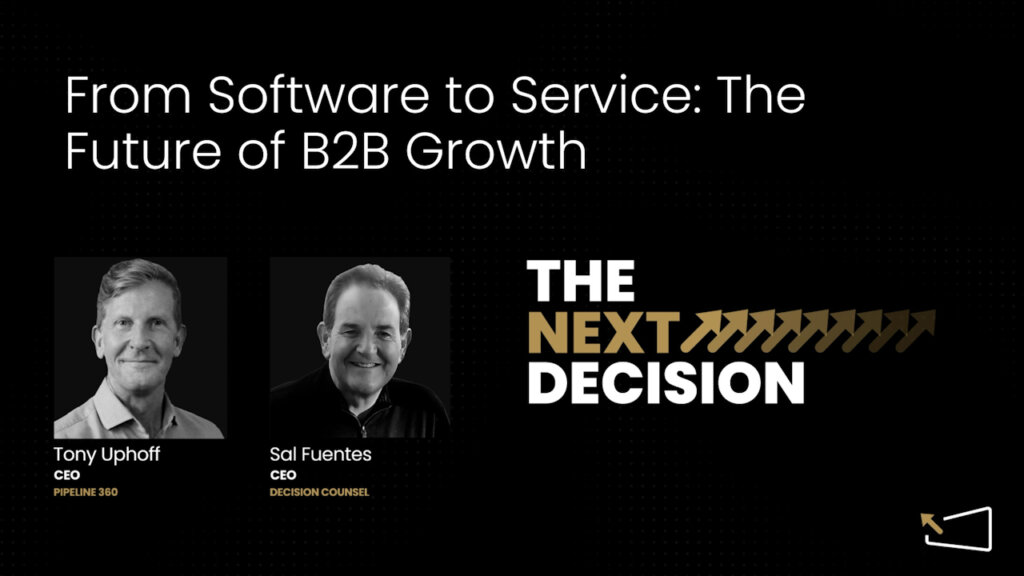
From The Next Decision Podcast: A Conversation with Tony Uphoff, CEO of Pipeline360, and one of the most experienced leaders in B2B go-to-market, demand generation, and enterprise transformation.
From The Next Decision Podcast: A Conversation with Tony Uphoff, CEO of Pipeline360, and one of the most experienced leaders in B2B go-to-market, demand generation, and enterprise transformation.
“AI is both overhyped and underhyped at the exact same time.”
That line from Tony Uphoff sets the stage for a fast-moving and deeply practical conversation hosted by Sal Fuentes on The Next Decision. As AI mainstreams and B2B teams face unprecedented change, Tony brings decades of pattern recognition to help leaders understand where growth is actually coming from.
In this post, we break down the major insights from the episode, including why AI will reshape the performance curve, how brand and demand are converging, and why the future of B2B may look less like software—and more like service as software.
AI Is About to Redefine the Performance Curve
Tony predicts that in 2026, AI will create three clear categories of B2B marketing teams: high-performing, mid-performing, and low-performing.
And the gap will widen fast.
“We’re overhyping how quickly AI will change everything in marketing—and underhyping the long-term impact it will have.”
Because B2B is deeply data-centric, AI’s impact will accumulate quickly—especially for teams that experiment early. Those who avoid the shift risk falling behind permanently.
Brand and Demand: A Convergence Decades in the Making
For years, brand marketing and demand generation have operated in separate silos—often with competing priorities and disconnected metrics.
Tony believes that era is ending.
“These motions have been fragmented for too long, and marketers have missed how powerful they are when fused.” With AI, better data, and unified orchestration, brand and demand are finally converging into a motion Tony calls branded demand. This shift will redefine how CMOs think about budgets, messaging, and measurement in 2026.
Tech Sprawl Is Collapsing Into Services
With more than 15,000 martech and adtech point solutions on the market, most organizations are drowning in tools and starving for outcomes.
When CFOs ask for ROI, many CMOs struggle to give a clear answer.
Tony sees a structural pivot emerging:
“We’re going from software-as-a-service to service-as-software.”
Instead of marketers stitching together dozens of disconnected systems, the future will emphasize unified, outcome-driven architectures—models like demand-as-a-service, where performance matters more than platform ownership.
The CRO, CMO, and the New Revenue Flywheel
Sal and Tony explore a leadership shift that is accelerating across B2B: the fusion of marketing and sales into a single go-to-market engine.
Historically, CMOs and CROs operated in parallel lanes. Today, the motions are inseparable.
Marketing is becoming a revenue discipline.
Sales is becoming a data discipline.
And the combined system is becoming a flywheel.
Companies are even experimenting with roles like Chief Growth Officer and Chief Churn Officer—leaders responsible for the entire revenue lifecycle.
This is more than a title change. It is a signal that B2B organizations are reorganizing around outcomes, not org charts.
When PLG Works—And When It Doesn’t
Product-led growth (PLG) is powerful, but Tony cautions that it is often misapplied.
As Sal observes: “If I’m buying a million dollars in networking equipment, I want someone to be accountable if it goes wrong.”
PLG works best for simple, low-risk products.
It breaks down when buyers need consultation, expertise, or confidence—especially in high-ticket or mission-critical categories.
This reality is why channel strategies are expanding, not disappearing, and why human expertise still matters in the enterprise.
Who’s Doing It Well?
Tony highlights several organizations executing at a high level:
• Shopify for innovative, experimental GTM evolution
• Salesforce, especially in global marketing execution
• GitLab, for creative and data-driven demand strategies
• Invisalign, surprisingly, for expanding from orthodontists into broader dentistry markets
Innovation is happening across mid-market and enterprise—not just in Silicon Valley.
Why This Work Still Fuels Tony After 30 Years
Late in the episode, Sal asks Tony what keeps him in the game after a decades-long career.
Tony’s answer: curiosity.
“I’ve never lost the fascination with how businesses grow, how decisions get made, and how marketing and sales create real impact.”
From CMP Media and Ziff Davis to enterprise SaaS, ABM, data, and now AI, Tony has witnessed—and shaped—every major B2B transformation. That continuity gives him a unique, grounded perspective on what’s next.
The Four P’s: A Framework for Decisions That Matter
Tony closes by sharing his decision-making framework—refined over thousands of executive decisions:
People
Do we have the right people, in the right roles, with the right tools?
Product
Are we building something the market actually wants?
Process
Are our systems scalable, repeatable, and designed to enable throughput?
Performance
The trailing indicator that reflects the health of the other three.
“When I get the first three right, performance usually follows.”
It is a simple, powerful diagnostic for leaders navigating uncertainty.
Listen to the Episode
Want the full conversation with Tony Uphoff?
Listen to Episode 7 of The Next Decision:
“From Software to Service: The Future of B2B Growth.”
Available on Spotify, YouTube, and wherever you get your shows.
Final Thought
If you are a CMO, CRO, or enterprise leader navigating the next wave of AI-enabled go-to-market, this episode delivers clarity when the market is full of noise. The winners of the next cycle will be the teams who simplify, unify, and focus relentlessly on outcomes—not software.
The future of B2B growth will not be powered by more tools.
It will be powered by better systems, better decisions, and better alignment.
Now is the time to build it.