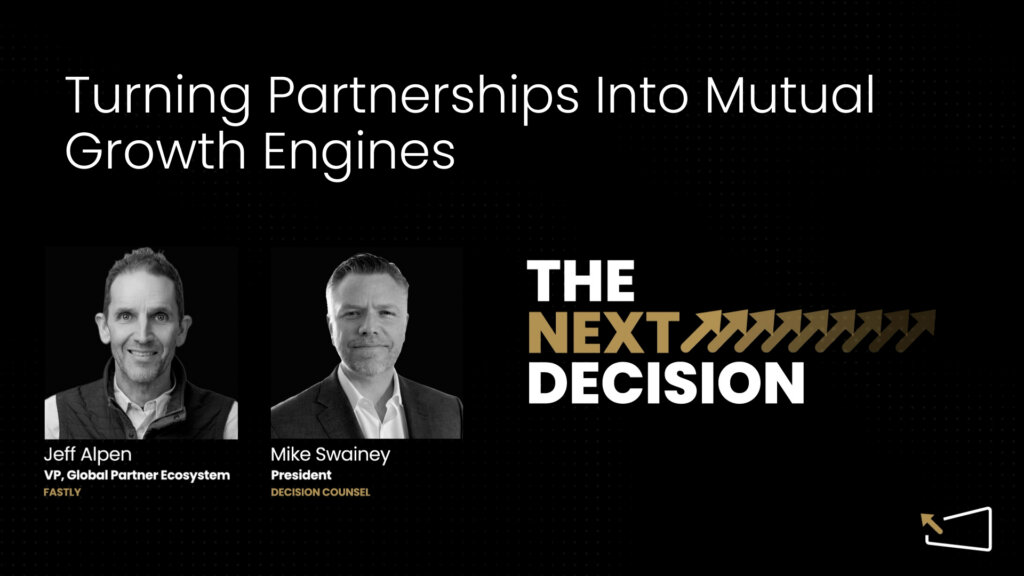
From The Next Decision Podcast: A Conversation with Jeff Alpen, VP, Global Partner Ecosystem at Fastly
“Do right for the customer. It’ll be good for the partner, and it’ll be good for Fastly.”
That’s the core philosophy Jeff Alpen, VP, Global Partner Ecosystem at Fastly, brought to his conversation with Mike Swainey on the latest episode of The Next Decision. In complex B2B markets, growth does not just come from a better product, a bigger sales team, or a stronger campaign. Increasingly, growth comes from the ecosystem around the company.
In this episode, Jeff and Mike unpack how partnerships are changing, why the best ecosystems create mutual value, and what it takes to make partner-led growth a real business strategy.
Partnerships Are No Longer Just a Channel
For years, many companies treated partnerships as a route to market. Partners helped resell, refer, co-market, or expand reach. But Jeff argues that the modern partner ecosystem has to do more than extend distribution. It has to help customers solve harder problems.
Today’s buyers are navigating more complexity, more technology choices, and more uncertainty than ever before. They are not simply looking for another vendor. They are looking for trusted advisors who can help them understand what matters, what fits together, and what will actually create business value.
That is where partnerships become strategic. They connect product capability to customer outcomes.
Mutual Value Has to Come First
One of the strongest ideas in the conversation is that the best partner ecosystems create value in three directions: for the customer, for the partner, and for the company.
Jeff describes Fastly’s approach as creating value first for the end customer, next for the partner, and then for Fastly. That order is important. When the customer wins, the partner has a reason to invest. When the partner wins, the ecosystem gets stronger. When the ecosystem gets stronger, the company grows.
Jeff also explains that partner value can take several forms. Economic value: does the partner make more money because of the relationship? Technical differentiation: can the partner solve more specialized problems because of the technology, tools, and enablement they receive? Brand value: does association with the ecosystem strengthen the partner’s position in the market?
The best partnerships may deliver all three. But the larger point is simple: partnerships work when value is mutual, not one-sided.
Enablement Is Never Done
A major theme of the episode is enablement. Mike and Jeff discuss why partner ecosystems cannot succeed through agreements alone. Signing a partner is not the same as activating a partner. Partners need to understand the technology, the market, the customer problem, and the value story.
But Jeff makes an important distinction: “Is the partner enabled? Wrong question. Has the partner been enabled today, this week, this month?”
That matters because markets like cloud, security, infrastructure, and AI move quickly. Customer needs change. Threats evolve. Technology shifts. Yesterday’s enablement may already be outdated.
For Jeff, enablement is not just a portal, a training deck, or a certification checkbox. It is an ongoing system that helps partners become smarter, more self-reliant, and more valuable to customers. He also points to where this is headed next. If yesterday’s model was a partner portal, tomorrow’s model may be an intelligent agent that understands what a partner needs, where they have gaps, and what content or tools will help them move forward.
In other words, the future of enablement is continuous, personalized, and always on.
Start With the Customer and Work Back
For growth leaders who want partnerships to become a bigger part of their revenue strategy, Jeff’s advice is clear: start with the customer and work back.
Before chasing a big logo, signing the latest AI company, or adding another partner to the slide, companies need to ask better questions. Who are we trying to serve? What problems do those customers need solved? What technologies help us serve them in a new or better way? Where do we have real experience? Where is the market going? How do we make money by solving those problems?
That discipline keeps companies from mistaking activity for strategy. A flashy partnership can create a strong press release. But that does not mean it will create durable revenue. The stronger move is to choose partners based on the customer problems you are uniquely positioned to solve together.
Focus Beats a Bigger Partner List
Another trap in ecosystem strategy is the belief that more is always better. More partners. More categories. More motions. More logos. But more does not always mean more growth.
Jeff and Mike discuss the importance of focus, especially for companies trying to build real expertise in a crowded market. The better model may be “fewer, bigger, better.” Instead of trying to become great at everything, companies should identify where they can build depth, trust, and repeatable value.
That means being thoughtful about partner selection. It means choosing relationships that align with the customer, the market, and the company’s ability to deliver. The strongest ecosystems are not always the biggest. They are the ones where the value is clear and the partners are equipped to win together.
Proof of Work Will Matter More
As the conversation turns toward the future of ecosystems, Jeff points to one idea that will become increasingly important: proof of work.
Today, many partner programs rely on tiers. Gold. Platinum. Premier. Strategic. But those labels can be hard for customers to interpret. Jeff believes the future will require more visible proof of what partners have actually done.
What problems have they solved? What migrations have they completed? What expertise have they demonstrated? What work proves they belong in the ecosystem?
This is especially important in complex categories like security, where trust matters and the stakes are high. For Jeff, the goal is for customers to enter the Fastly ecosystem and trust that the partners they see have been validated, vetted, and recognized as capable of helping them succeed.
The Takeaway: Partnership Is a Path to Growth
If there’s one message at the center of this episode, it’s this: partnership is not just a channel strategy. It is a growth decision.
At the end of the conversation, Mike asks Jeff what decision leaders need to make if they want their partner ecosystem to become a real growth driver. Jeff’s answer is direct. Leaders have to get past the belief that business is always zero-sum.
Yes, markets are competitive. Yes, revenue matters. Yes, companies have to protect their own interests. But the strongest ecosystems are built by leaders who believe that other companies, experts, and partners can help them advance their mission in ways they may not fully understand yet.
As Jeff puts it: “Partnership is a path to growth.”
Listen to the Episode
Want the full conversation with Jeff Alpen?
Listen to the latest episode of The Next Decision: “Turning Partnerships Into Mutual Growth Engines.”
Available on Spotify, YouTube, and wherever you get your podcasts.
Final Thought
For revenue leaders navigating complex B2B markets, this episode offers an important reminder: partnerships are not just a route to market. They are a way to create trust, extend expertise, and help customers turn complex technology into real outcomes.
The companies that win will not be the ones with the longest partner list. They will be the ones that build ecosystems with focus, enablement, proof, and mutual value.
Because in the end, growth is not just about what you can sell. It is about what you can build with others.