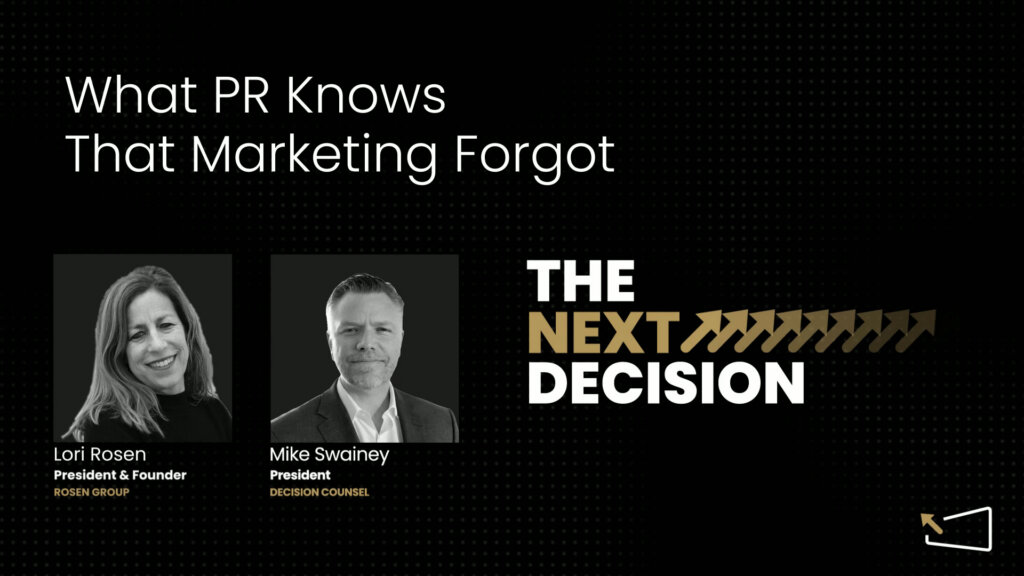
From The Next Decision Podcast: A Conversation with Lori Rosen, Founder and President of Rosen Group PR.
Anyone can publish now. Very few people get quoted.
In this episode, Mike Swainey talks with Lori Rosen, Founder and President of Rosen Group. Lori has spent more than 40 years in earned media. Her career runs from issue advocacy on Capitol Hill, to selling ad space in New York, to building an agency that launched the Chrysler minivan and at one point represented nearly 20 magazines at once.
Lori’s thesis: that the media landscape has changed constantly, from three networks to cable, cable to streaming, streaming to social, and now to AI, but the fundamentals of PR have not. Authoritative third-party coverage still decides who rises to the top, whether someone is searching Google or asking Gemini. From there, the conversation turns to a harder question for every brand that can now publish at will: when everyone can be louder, what actually earns trust? Lori’s answer runs through candor and accessibility, media relationships built with no strings attached long before they’re needed, and a continued bet on the A-list placement.
The throughline is that visibility and credibility are not the same thing. AI makes it easier than ever to be seen. It does nothing to make a brand worth quoting, and no volume of content will get a company out of a trust problem.
The following transcript has been edited for clarity and length.
The Next Decision, Episode 16
Guest: Lori Rosen, Founder and President, Rosen Group
Host: Mike Swainey, President, Decision Counsel
Mike Swainey:
Welcome to The Next Decision, the show about the choices revenue leaders make when markets shift, growth gets challenging, and the old playbooks stop working. I’m Mike Swainey, President of Decision Counsel. On this show, we talk with leaders about the decisions that shape modern growth, from brand and demand to technology, customer experience, communications, and go-to-market strategy.
Today, I’m super excited to be joined by Lori Rosen, President and Founder of Rosen Group. I love the conversation we’re going to get into today, Lori, because lately on the show we’ve been digging into brand. We’ve been digging into partner marketing. We’ve been digging into consulting.
But today we really get to dive deep into the wide world of media, analyst, and public relations. And I’m super excited because you’ve spent your career in this space, helping companies and leaders navigate some really tough PR and media landscape moments. I feel like you’ve seen the industry shift over your career from traditional media to digital to social, all of these elements that end up becoming differentiators, but also change agents for what we’re actually seeing and doing today. And I love that you have the visibility and the experience to share with our audience. And now we have AI as the elephant in the room, fueling even faster change.
I’m curious what your take will be on how, just because I can publish or put a ton of noise into the market, maybe it doesn’t mean I should. Or maybe it doesn’t quite add up to the trust that I think it does, because PR knows things that marketing may have forgotten. I want to dive into that with you today, especially around the power of relationships and the power of relevance.
So, Lori, with that, welcome to The Next Decision.
Lori Rosen:
Thank you very much. I mean, there’s a lot going on in our industry. AI is obviously the buzzword du jour, but over the decades I’ve been in this business, there’s always change. The change can start from three TV networks to cable, cable to streaming, streaming to social. Digital, of course. The internet comes alive, and all of a sudden you can get an article in the Chicago Tribune and it becomes national because it’s posted online. So there are all these iterations of the media and the media landscape changing.
And AI is just our latest shiny tool, which we’re leveraging to a large extent.
I’ll go right into that. When Google started, we had SEO, and articles gave authority and credibility. The more articles we had, the better our clients would rank online and pop up first. Of course, if there was a negative article, we had to deal with that too. But for the most part, the links and getting coverage on any digital outlet were key.
And now people are saying, well, what about AI? It’s just as important, because earned media, or authoritative third-party mentions, work the same way. Gemini and ChatGPT, they’re all looking, and if there are articles, they’re going to rise to the top. So it’s the same concept of maintaining and getting visibility. The crawlers are looking at it, and it’s just as effective. Maybe it’s a different type of work, but it’s still there.
Mike Swainey:
It’s fascinating for sure. The pace of change, I think, is unlike anything we have seen. And from a pure marketing standpoint, the impact it’s having is transformational. That word gets thrown around a lot, but in this case, I really feel like it is.
As things have changed, some things have certainly stayed the same. When you look back on your career, what are some of the things you feel have changed the most or been the most impactful? And what led you to start Rosen Group?
Lori Rosen:
I went to school in Washington and interned my senior year. I had no idea what PR was, but it sounded kind of cool, and I instantly liked it. So why did I like it? I loved, and still do 40-plus years later, the thrill of media coverage.
When I first started in Washington, we did a lot of issue-oriented clients. We weren’t lobbyists, but we were trying to influence policy on Capitol Hill. And for a young person, there was nothing more exciting. Then I moved to New York on a bit of a whim. I worked for a few other agencies, and I also sold advertising space for a couple of years. So I learned the media business pretty well from both sides: circulation, the journalism side, the advertising side. But I always missed PR. I liked the idea of generating news coverage. So I went back to a firm, then had the opportunity to go out on my own and decided to try it.
And I still say, if it doesn’t work, I’ll go get a real job. That’s been my mantra. It’s kept me going all these years.
Mike Swainey:
I love it.
Lori Rosen:
Initially, we started with one project for Chrysler, introducing the minivan. From there, we did other automotive work, and that led to Car and Driver magazine. So we started working with media companies, and that was a big specialty of ours for years. We did magazine launches, we worked with established brands. It was a lot of fun. At one point, I think we had 18 or 19 magazines on our roster.
Then 2007, 2008 happened. An economic shift. We had other clients, so we weren’t relying on one industry, and that was a good lesson. We expanded to industry associations, advertising agencies, marketing agencies.
So the business has evolved over the years, but what makes it still so exciting? I go back to the thrill of the placement. At my agency, in our Slack, we have a channel called Awesome Placements, where we share client coverage: Forbes, wherever it is. I see a placement and I go, oh my God. I get so excited about earned media coverage, as long as our staff and clients are too. That’s why clients hire us, for the most part. We obviously do more than just earned media, but that’s still our core. So that’s what I like, and that’s what keeps me going.
Mike Swainey:
It’s interesting, because there is a threshold that has to be met for something to be considered newsworthy, or for an editor to think their readers would actually want to consume it. I think everybody thinks they have a story to tell that’s newsworthy. Hey, we hired somebody, let’s put out a release. It’ll definitely get picked up.
Lori Rosen:
Right.
Mike Swainey:
There’s got to be a threshold here, right? When everybody thinks they have news, how do you know whether it’s going to be newsworthy? What does that threshold look like?
Lori Rosen:
There are a few things. Back in the day, and there still are, press releases might get published in one or two industry trades. But for the most part, we use them as a tool to create excitement and energy.
I remember we had a client, and we kept grinding out news releases month after month. Nobody was picking them up, and it was frustrating to us. Then maybe by the eighth month, the Wall Street Journal called and said, what’s going on at this company? Because you keep sending us stuff, so something must be going on. That’s an example of how you’ve got to be out there and keep promoting, whether it’s a one, five, or ten in terms of newsworthiness. If you’re not out there, somebody else is going to take that space. So that’s one way of thinking about it.
The other thing is, we call ourselves newsjackers. We watch the news, we see what trends there are, and then we hit it from the other end. We insert our clients into the conversation. So we cover news angles that way.
And when all else fails, we create our own news. We suggest that a client do a survey on their own industry, or on a larger related industry. We use SurveyMonkey or whatever other tool, get the data, and grind it out. That’s usually a good tactic to create our own news and then pitch it. There are a lot of ways to skin the cat. Is there a threshold? No. We just pivot and keep going until we find the right combination.
Mike Swainey:
I think it goes without saying that a lot of marketing teams, a lot of brands, can now publish directly. That doesn’t necessarily mean they have something meaningful to say. I bet you run into that every once in a while. Okay, you did that. It’s fine, it’s more noise, but good luck. It may not get you the impressions or whatever KPI you’re looking for, and it certainly might not be a growth driver for you.
With that as context, I feel like we’re beginning to center in on the idea I really wanted to dive into today. We’re in a world where it might be easy to chase visibility, to be front and center. We see that with influencers and TikTok and Instagram Reels. You can publish content on your own owned media channels as well. You can post, publish, pitch, whatever it is, all day long.
But trust and credibility aren’t so easy. You can’t just press the magic TikTok button and have all the brand trust in the world. In fact, in some cases you see brands making mistakes. One recently, and I’m curious about your take on this, I thought was an absolute disaster: the Callaway and Good Good campaign. Good Good is a media company that does kind of provocative video, let’s just say, and there was a guy who runs over and pushes a woman down on the golf course. “Don’t touch my driver.” I’m like, what is happening? How could that ever have been greenlit? And it’s like, well, we’re so cool, we’re going to make this viral and it’s going to be awesome. Cheap, fast, go. And then something like that happens.
Lori Rosen:
We were just talking about that earlier today in the office. It was absurd. It makes no sense when these things are greenlit. But you’re right, people start to believe their own hype.
Mike Swainey:
Like, I’m bulletproof. Or, it’s a joke.
Lori Rosen:
Bulletproof. And just so sassy and out there. And then the other one, with Sydney Sweeney. That was another kind of disaster. They doubled down on it.
Mike Swainey:
Yeah.
Lori Rosen:
Some might think that now people are going to remember these company names. I don’t know. I think if they had to do it over again, they probably wouldn’t. But you can rationalize it that way, that it certainly got a lot of attention.
Mike Swainey:
At the end of the day, it’s chasing visibility at the expense of credibility and trust. And I feel like that’s the biggest thing. In the case of Callaway, they have a forever chemical they’re going to have to figure out a way to work through. If we had more time, I’d love to dive in on how you would advise Callaway. Maybe we’ll come back to that.
But how do you help leaders understand the difference between just being visible, having the brand out in the space, and actually being trusted, or better, having something meaningful to say?
Lori Rosen:
I’ll go back in the day, to business leaders. This isn’t new anymore, but what’s his name, from Chrysler? Lee…
Mike Swainey:
Lee Iacocca.
Lori Rosen:
He was in the car…
Mike Swainey:
Right.
Lori Rosen:
He was the first CEO who became a household name. And I think he broke the mold for others, because CEOs were protected. They were behind their desks and closed doors and six layers of assistants. They really didn’t do media until he came along. And it worked, and it was smart, and he helped bail out the company.
So that’s a good lesson. Mr. CEO, get your media training, listen, and follow through. Be transparent and be accessible, because accessibility and transparency are the hallmarks of a good leader and a good company. Endear yourself to the media, so that if something does happen that’s not great, you’re human, and you already have established relationships.
So we like to do what we call media briefings. Hey, meet our CEO for coffee or dinner. No strings attached. We just want you to get to know each other. That happened a lot before COVID. Now that COVID is, thankfully, in the distant past, we’re starting these in-person meetings again. I would take that over any other route for media relations and brand building.
Mike Swainey:
If you were to tell a leader, look, this is the one thing you’ve got to do to make it worth quoting or interviewing you, what’s that one thing? What’s going to make an editor say, oh, I should talk to this person? What’s that thing you’re putting out into the universe that makes an editor say, okay, I need to interview this person?
Lori Rosen:
Well, as I said, be candid. There are certain leaders who have more personality and more natural ability to woo reporters. But, and I hate to say this, have your talking points. Stick to what you want to get across, and then say it about five different ways until it resonates. As I said, some leaders are just natural, and some aren’t. But keep at it, and it works.
Mike Swainey:
Let’s go back to what we were talking about at the outset, AI. Again, just because you can doesn’t mean you necessarily should. Everybody can be a little bit louder now. Everybody can flood the zone with content, but it might not actually be worth anything. Is AI creating a trust problem?
Lori Rosen:
Well, it’s definitely flooding the zone, that’s for sure. LinkedIn was such a powerful channel for business people, and still is to a certain extent. But now, in my opinion, leave your personal stuff out. That’s for Facebook or Instagram or wherever you want. Stick to the program, and it will be more effective. Rather than, “Oh, I never usually say this on LinkedIn…” Then don’t. I’ve seen it going in that bad direction. Is that AI-driven? Probably to a certain extent, because it’s easy to ask your chat friend to write something up for you. But I would be a little judicious in that regard.
Mike Swainey:
For sure. Whether it’s AI or just user- or brand-generated content, everybody has access to the same tools. One of the things we’ve been seeing as a result is that a sea of sameness is creeping into a lot of communications. Everybody looks and sounds the same. With PR and media relations, I feel like there’s a renaissance coming in being able to leverage the media to break out of that. Do you think PR is even better suited these days to help folks get out of that sea of sameness?
Lori Rosen:
Well, it’s more challenging. The landscape is broader, but it’s also more fragmented. For instance, you would get a piece in The New York Times and you could sit back for six months. Everyone read it, and it landed everywhere. Back in the day, there were reprints and this and that, and there wasn’t a lot else. Today, you get a piece in The Times, and it’s still my top target, and it does hit. But five minutes later, it’s like, what’s next? Because there’s limited attention. People are on and off and all that.
So that’s the good news and the bad news. The good news is that it’s still important. The bad news is that each piece isn’t as lasting, so you have to do more of it. But there are more outlets to pitch. It’s a little more time-consuming. And there are also sites and Substacks now, a whole other avenue to pitch. There are just a lot of other media outlets and channels available.
Mike Swainey:
You and I have seen enough. I remember being in the office as a wee lad, and whether it was an issue of Adweek or The Times or whatever, it would get routed around the office, around the team, even if there were only five, six, eight of us. You’d have a little library-style signature: I’ve seen it, on to the next person. And it would go in the interoffice mail.
Lori Rosen:
And you’d check the little box on the Post-it note.
Mike Swainey:
Right, right. But the funny thing is, that information was already dated by the time you got it. I’ve got the September issue on October 9th. And I’d wait another week until I got another article passed around the office. So that’s one of the benefits of the time we live in now. It’s given us much greater access to information.
Lori Rosen:
Well, you know, when I think about…
Mike Swainey:
Oh, go ahead.
Lori Rosen:
No, I was going to say, I still read like that. I read the aggregator sites on media. I read a lot. Obviously I don’t read everything, but I make a point of it, and I share articles with my staff. They always ask how I have the time to do these newsletters, and I say, you’ve got to make the time. There’s a lot going on, but you really do have to stay on top of it.
When I first started in Washington, somebody was in charge of The Washington Post. They read the whole thing and then shared the relevant pieces with the staff. That concept still holds. You’ve really got to be on top of the news to thrive and do well in this business.
Mike Swainey:
I agree, and I think that’s a good transition to the third arc of our show today, which is reputation and crisis. We touched on it a little earlier with Sydney Sweeney and with Good Good and Callaway. Trust is hard to build, but boy, is it easy to lose. I know that’s the trope, but it’s a universal truth.
Whether it’s a launch or a crisis or a funding moment, you need to have that trust and credibility. You can’t say, okay, we have a launch tomorrow, snap my trust fingers together, and we’ll magically have it. So often, the brands I’ve worked with over my career realize they need that trust exactly at the moment when it’s hardest to create, or worse, during a crisis.
So how do you advise the leaders you work with that now is the time to build that trust? Get that money in the bank before you need to spend it. What do you do to get them started? Because it can feel like there’s plenty of time, and with today’s never-ending news cycle, that’s just not the case.
Lori Rosen:
That’s what I said. Reputation management is continuous. It’s not episodic, where you do something when you want to take advantage of a moment. That’s why it goes back to relationship building, and to reaching the key media people who will remember you, who know you because you gave them a good quote or answered something off the record. It’s important so that when a crisis does come, there’s a little more leeway and a little less judgment on whatever the situation is.
You also have to have a crisis communications plan in place: who the spokespeople are, what the parameters are, who shouldn’t speak with the media. We work with a financial services company, and this just happened recently. One of their people spoke with the media about something they shouldn’t have, and it’s like, how does this happen? We have all of these protocols and layers in place. Which memo didn’t you get? So those rigid, regimented processes have to be reinforced, and you can’t let your guard down.
Mike Swainey:
It is remarkable when you see something like that happen. It shouldn’t, but it does, probably more often than we’d like to admit.
One of the things I’ve found in my career: I’ve been fortunate to work at a number of integrated agencies that offered public relations, media relations, and analyst relations, sometimes as a side hustle and sometimes as a real center of excellence. But I’ve never worked at a traditional, full-service PR agency. I’ve always been adjacent to it, which makes me dangerous.
Lori Rosen:
Right.
Mike Swainey:
Because then I think I know more than I probably do. But from a growth perspective, the idea of an integrated program, in our speak, means offering a multichannel approach, whether it’s paid media, organic, or your outbound or inbound plays. Public relations is a big part of that as well.
How are you tying reputation, coverage, or newsworthiness to growth? Do you tend to look at it that way, or more from the standpoint of, hey, we got coverage in these publications? What do those KPIs look like, and is growth ever one of them?
Lori Rosen:
Well, growth. A client of ours recently got a big investment and will be acquired, and I can fully say it was because we kept building their profile and their leader’s profile. Top 10 lists, 40 Under 40. We hit it from all different directions. And I think that’s the ultimate measurement. If that’s the goal, and who doesn’t want to be acquired these days, that’s a total home run in terms of a KPI. We built the profile, and someone came and found the company.
Mike Swainey:
And reputation is certainly one part of that. Having that money in the bank, I would assume, does more to get you on the radar than whether you ran a huge ad campaign. We are trusted. We are known. We are credible. This is not our first rodeo. I’m sure that helps.
Thinking about marketing writ large and PR, do you work closely with partners in pure marketing to help build and protect that credibility and trust over time, or is it more siloed? I could see the integration being impactful, but I’m genuinely curious how you typically work with marketing departments, either inside or outside a brand.
Lori Rosen:
We’re working more and more with marketing departments, because that’s just the dynamic with clients lately. They’re doing white papers, and we’re weighing in on what the questions should be and what the report should be, and then, of course, promoting it. When we’re part of the process where they’re shaping ideas and direction, and we offer our strategic input, it helps us, because we know what’s going to be newsworthy on the other end. So those types of integrations are helpful.
And if a client is doing an ad campaign, we’re going to promote the ad campaign. Those days are fewer and fewer, because there’s less and less media covering those types of things. But that’s one way we’re integrating with marketing. There are crossovers, but we also stay in our lane to a certain extent, which is earned media.
Mike Swainey:
I want to start to take us toward the close. I have one more question that we ask every guest on the show, and frankly, this has been such a great conversation that I want to ask you two questions.
First and foremost, what advice would you offer an organization that wants to leverage public relations to drive the brand or drive growth? If there were one thing, your 30 seconds in the elevator, what might that be?
Lori Rosen:
I’m going to go back to my roots. Coverage, a seat at the CNBC table, going for a profile or an op-ed in The Times or the Wall Street Journal. Even though there’s a lot of media, and a lot of good media options, the A-list media is where I’d go to get that big hallmark article that gives a lot of cover for a brand. I think those are important. It’s not a viral TikTok video. I’m still bullish on A-list, highly regarded print, digital, or broadcast media.
Mike Swainey:
This show is called The Next Decision because we see growth as a series of decisions that lead brands to achieve their goals, whatever the KPI. For a leader who wants to drive real credibility and real trust in the market, what’s the first decision? What’s the first thing they need to do to get started tomorrow?
Lori Rosen:
Examine internally what their biggest assets are. What’s their secret sauce? Build a story and a creative brief around that, and then publicize the heck out of it. Take it on the road, so to speak.
Mike Swainey:
I love it. That is the perfect place to leave it. Lori, I have so appreciated having you on The Next Decision today. I loved the conversation. I knew it would be super robust. You have so much amazing experience and so many great stories. I loved hearing them.
Lori Rosen:
I’m impressed with your knowledge of PR.
Mike Swainey:
I don’t know if I hold a candle to you. But look, the big takeaways for me are that visibility is not the same thing as credibility or trust, and content certainly is not trust. It’s incumbent upon brands to recognize that they cannot content or AI themselves out of a trust problem. And I’ll be curiously following the Callaway story to see where they take it.
Thanks to everyone listening today to The Next Decision, brought to you by the amazing people and minds at Decision Counsel. We’ll see you next time. Thanks again, Lori. I really appreciate having you today.
Lori Rosen:
Thank you.