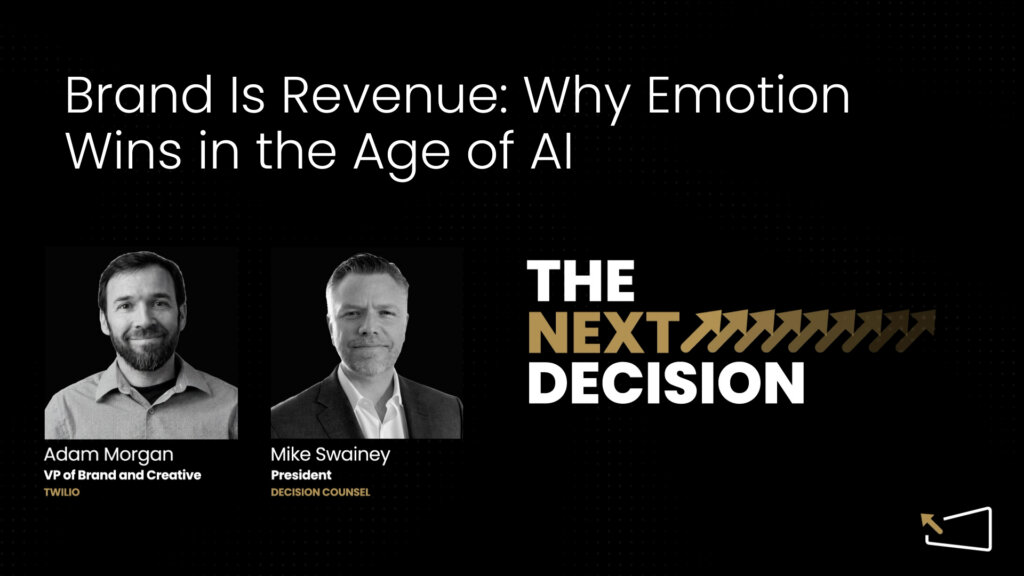
From The Next Decision Podcast: A Conversation with Adam Morgan, VP of Brand at Twilio
“Emotion is not the enemy of business performance. Emotion is one of the reasons business performance actually happens.”
That’s the central idea Adam Morgan, VP of Brand at Twilio and author of Sorry Spock, Emotions Drive Business, brought to his conversation with Mike Sweeney on the latest episode of The Next Decision.
As AI transforms marketing, sales, and customer engagement, many B2B leaders are asking the same question:
What role does brand still play in a world dominated by automation, analytics, and performance marketing?
Adam’s answer is clear: brand matters more than ever.
In this episode, Adam and Mike unpack why emotional connection is becoming a competitive advantage in modern B2B growth strategy, how creativity drives measurable business outcomes, and why companies that reduce marketing to dashboards alone risk becoming forgettable.
The False Choice Between Creativity and Performance
For years, B2B companies treated brand and performance marketing like opposing forces.
Brand was seen as soft. Performance was seen as measurable.
Adam argues that mindset is fundamentally outdated.
“People still buy emotionally and justify rationally. That hasn’t changed just because we now have AI and more data.”
The conversation explores how many organizations unintentionally strip emotion out of their messaging in pursuit of optimization. The result is often highly efficient marketing that nobody remembers.
Mike points out that growth teams today operate under enormous pressure to prove ROI quickly, especially in private equity-backed or efficiency-focused environments. That pressure often pushes teams toward short-term metrics while undervaluing the long-term effects of brand trust, memorability, and emotional resonance.
Adam challenges that thinking directly.According to him, creativity is not decoration layered onto strategy. Creativity is strategy.
AI Is Raising the Value of Human Emotion
One of the episode’s strongest themes is the changing role of AI in marketing and communication.
Rather than viewing AI as a threat to creativity, Adam sees it as a force that will amplify the importance of distinctly human storytelling.
“As AI makes content generation easier, the real differentiator becomes emotional insight and originality.”
The discussion reframes AI not as the replacement for branding, but as the reason strong branding becomes even more necessary.
If every company can generate competent content instantly, then sameness becomes the new risk.
What stands out?
Taste. Perspective. Voice. Emotion.
Adam explains that audiences increasingly crave signals of authenticity and humanity, especially in B2B categories that historically leaned heavily on technical messaging and feature comparisons.
The companies that win won’t simply produce more content.
They’ll create work people actually feel something about.
Brand Is Not Just Awareness. It’s Revenue Infrastructure.
A major takeaway from the conversation is that brand should not be treated as a separate awareness function disconnected from business outcomes.
Adam repeatedly returns to the idea that brand shapes every downstream growth metric.
Pricing power. Customer retention. Sales conversion. Market trust. Expansion. Recruitment. Investor confidence.
All of these are influenced by how a company is perceived emotionally.
“Brand isn’t the thing you do after the product works. Brand is part of what makes the product valuable in the first place.”
Mike and Adam discuss how many executive teams still struggle to connect emotional storytelling to revenue performance because attribution models tend to favor immediate measurable actions.
But just because something is difficult to measure precisely doesn’t mean it lacks impact.
In fact, Adam argues the opposite:
The most valuable business drivers are often cumulative, emotional, and long-term.
The Best B2B Brands Make People Feel Something
The episode also challenges the long-standing stereotype that B2B buyers operate purely rationally.
Adam points out that business decisions still involve human beings trying to reduce risk, gain confidence, build status internally, and align themselves with companies they trust.
Even highly technical buying decisions are emotional underneath the surface.
That insight changes how messaging should work.
Instead of relying exclusively on specifications, product capabilities, or feature comparisons, Adam encourages marketers to think about:
- What emotional tension exists for the buyer?
- What fear or uncertainty are they trying to resolve?
- What future identity or outcome are they moving toward?
- What story does the customer want to believe about themselves?
The strongest brands answer those questions clearly.
Creativity Requires Courage
Another recurring idea throughout the conversation is organizational fear.
Adam explains that many companies unintentionally flatten their marketing because consensus-driven environments tend to produce safe decisions.
But safe work rarely creates differentiation.
“Most breakthrough creative work feels uncomfortable at first.”
Mike and Adam discuss the challenge of balancing stakeholder alignment with the need to create marketing that actually cuts through.
The companies that stand out are often the ones willing to take calculated creative risks while maintaining strategic clarity.
That does not mean being reckless.
It means understanding that memorability itself has business value.
The Takeaway: Emotion Is Still the Competitive Edge
If there’s one message at the center of this episode, it’s this:
AI may change how content is produced, but it does not change how humans make decisions.
People still respond to trust. Meaning. Identity. Emotion. Story.
The organizations that understand that will build brands capable of surviving technological shifts rather than being commoditized by them.
As Adam puts it:
“The future doesn’t belong to companies that automate everything. It belongs to companies that understand humans better.”
Listen to the Episode
Want the full conversation with Adam Morgan?
Listen to the latest episode of The Next Decision: “Brand Is a Revenue System: Why Emotion Still Wins in the Age of AI.”
Available on Spotify, YouTube, and wherever you get your podcasts.
Final Thought
For revenue leaders navigating the AI era, this episode offers an important reminder:
Efficiency alone is not enough.
As automation expands and content becomes increasingly commoditized, emotional differentiation becomes more valuable, not less.
The companies that grow sustainably will be the ones that combine data with humanity, performance with creativity, and systems with stories.
Because in the end, people do not remember the most optimized message.
They remember the one that made them feel something.