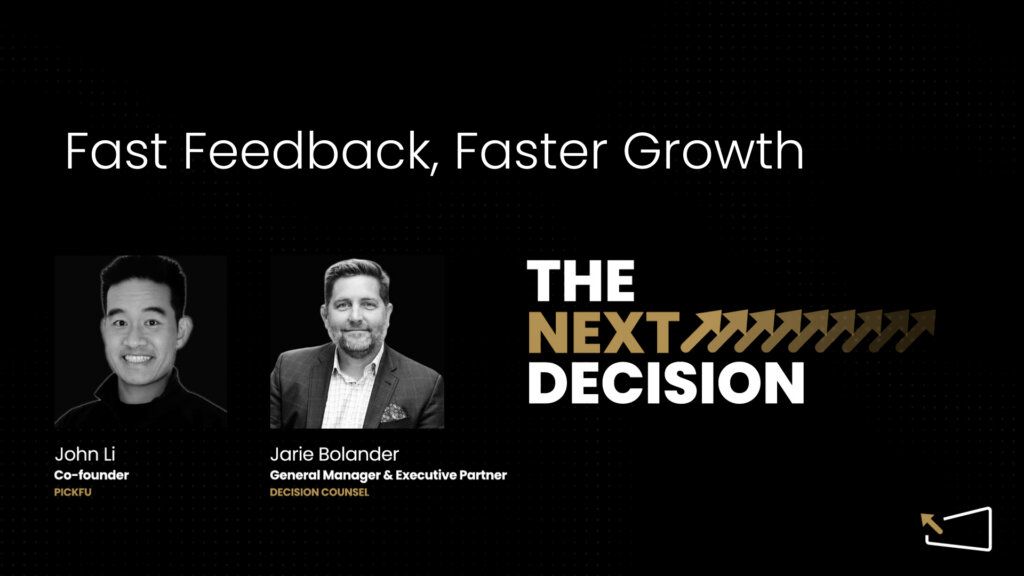
From The Next Decision Podcast: A Conversation with John Li, Co-Founder of PickFu
Listen on your favorite podcast platform
“Most companies don’t fail because they lack ideas. They fail because they don’t test them.”
That idea anchors this episode of The Next Decision, hosted by Jarie Bolander.
As markets move faster and competition tightens, John Li explains why feedback speed now determines growth speed. The difference between guessing and testing isn’t subtle. It’s structural.
In this recap, we break down:
- Why guessing is expensive
- How real-time polling shortens decision cycles
- What validation before launch really looks like
- Where growth advantages now come from
Guessing Is a Growth Tax
For years, teams relied on internal consensus.
Brainstorms.
Stakeholder debates.
Executive instinct.
That model worked when markets moved slower. Today, delay compounds.
“The cost isn’t being wrong. It’s being wrong at scale.”
Launching without validation means spending budget on creative that doesn’t convert, features customers don’t value, and messaging that misses.
Fast feedback shrinks that risk window.
Instead of weeks of debate, you test.
Instead of assumptions, you measure.
Growth accelerates when uncertainty drops.
Real-Time Feedback Changes the Loop
One of the sharpest insights in the episode is simple:
Feedback speed rewires how companies operate.
When you can test headlines, positioning, packaging, or pricing in hours, decisions tighten. What once required extended research cycles now fits inside a sprint.
“You don’t need more opinions. You need signal.”
Structured polling transforms subjective debate into directional data. It doesn’t remove judgment. It sharpens it.
Instead of arguing internally, teams ask the market.
And the market answers.
Validation Before Launch
Validation isn’t about perfection. It’s about clarity.
John outlines how teams use rapid consumer polling to test:
- Messaging variations
- Creative concepts
- Product names
- Feature prioritization
These are small experiments with low cost and high leverage.
Instead of scaling uncertainty, teams refine before exposure. The shift is subtle but powerful.
From launch and hope
to
test and then launch.
Micro-Experiments, Macro Impact
Traditional growth strategies revolve around large bets.
Major campaigns.
Big feature releases.
High-visibility launches.
Fast feedback flips the model.
Run more experiments.
Reduce blast radius.
Iterate faster.
Each micro-test compounds into smarter decisions.
“The market will tell you. You just have to ask.”
When testing becomes habitual, learning compounds. Teams move with confidence instead of hesitation.
The Advantage Lives in Speed
Old advantages came from budget and distribution.
Today, advantage often comes from speed.
If you can validate faster than competitors, you adjust faster. If you adjust faster, you scale faster.
Feedback becomes infrastructure.
Not an afterthought.
Not a final checkpoint.
An embedded loop inside every decision.
The Takeaway: Test First
Growth doesn’t reward certainty. It rewards learning velocity.
Real-time validation reduces risk, improves clarity, and aligns teams around evidence instead of hierarchy.
For founders and operators, the signal is straightforward:
Don’t scale assumptions.
Scale what works.
“Speed isn’t about moving fast. It’s about reducing wrong turns.”
Listen to the Episode
Catch the full conversation with John Li in The Next Decision:
Fast Feedback, Faster Growth
Available on YouTube, Spotify, and wherever you get your podcasts.
Final Thought
Markets move quickly.
The teams that win aren’t guessing better.
They’re testing sooner.