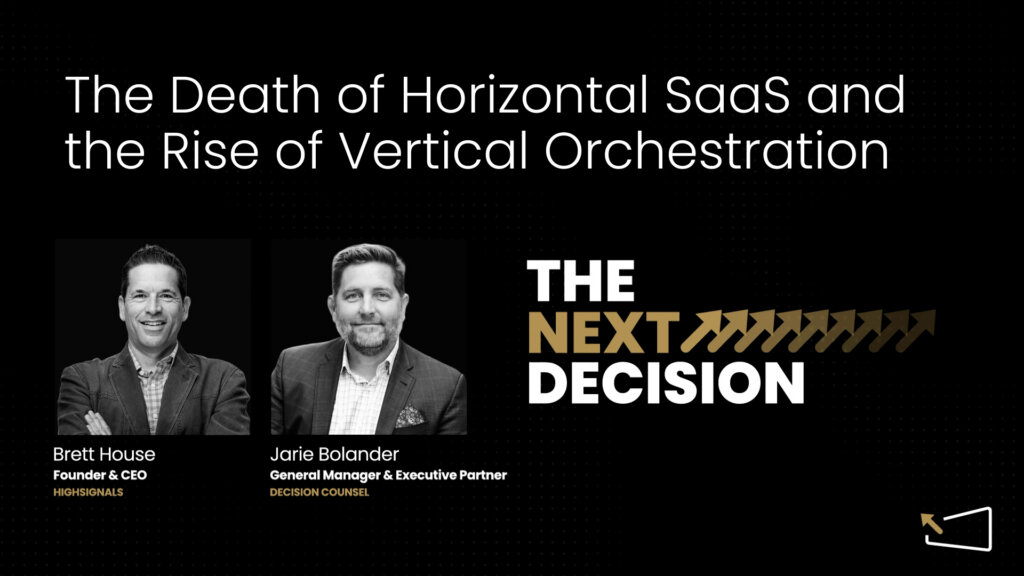
From The Next Decision Podcast: A Conversation with Brett House, Founder & CEO of HighSignals
“Horizontal SaaS is structurally fragile in an AI-native world.”
That’s the core tension explored in this episode of The Next Decision, hosted by Jarie Bolander.
As AI reshapes how software gets built, deployed, and monetized, Brett House explains why the old horizontal SaaS model is losing ground and what replaces it.
In this recap, we break down:
- Why horizontal SaaS is under pressure
- How AI collapses software categories
- What “vertical orchestration” really means
- Where defensibility now lives
Horizontal SaaS Was Built for a Different Era
For years, horizontal SaaS thrived by solving broad problems across industries.
CRM.
HR.
Marketing automation.
General tools for general use cases.
But AI changes the economics.
“When intelligence becomes embedded, the value shifts from the tool to the outcome.”
AI reduces the need to stitch together multiple systems. Buyers don’t want more features.
They want the job done.
The old model optimized for seat licenses and feature expansion.
The new model optimizes for domain depth and execution.
AI Collapses Categories
One of the sharpest insights in the episode:
AI compresses layers of software.
When models can reason across data, summarize context, generate outputs, and automate decisions, entire categories shrink.
What once required three platforms may now require one orchestrated layer.
“AI doesn’t just enhance software. It reorganizes it.”
This puts pressure on horizontal tools that relied on integrations and ecosystem sprawl.
If intelligence sits on top, the orchestration layer becomes the strategic asset.
From Vertical SaaS to Vertical Orchestration
Vertical SaaS isn’t new.
But Brett argues we’re moving beyond vertical software into vertical orchestration.
That means:
- Deep industry-specific data models
- Embedded AI tuned to domain nuance
- Integrated workflows from input to outcome
Not a tool.
A system.
Instead of selling software to hospitals, you orchestrate patient intake, documentation, billing, and compliance in one intelligence layer.
Instead of selling tools to financial advisors, you orchestrate portfolio construction, reporting, and client communication end-to-end.
The defensibility shifts from UI to domain intelligence.
The New Moat
Traditional SaaS moats relied on:
- Switching costs
- Feature expansion
- Ecosystem lock-in
In an AI-native world, the moat becomes:
- Proprietary data
- Domain-specific fine-tuning
- Embedded workflows
- Outcome ownership
“The product isn’t the dashboard anymore. It’s the orchestration.”
That’s not incremental. It’s structural.
Founders building horizontal utilities may find themselves squeezed between foundational AI models on one side and vertical orchestrators on the other.
Tech Follows Incentives
As Jarie points out, adoption follows economics.
AI reduces marginal cost. Buyers respond.
If a vertical orchestrator can replace multiple subscriptions and deliver measurable outcomes, budget shifts quickly.
This isn’t just product evolution.
It’s capital reallocation.
The Takeaway: Build Where Value Accumulates
Horizontal SaaS isn’t disappearing overnight.
But its center of gravity is shifting.
AI rewards specificity.
It rewards workflow ownership.
It rewards alignment between intelligence and outcome.
For founders and operators, the signal is clear:
Don’t build another feature layer.
Build the orchestration layer.
“Categories don’t die quietly. They get reorganized.”
Listen to the Episode
Catch the full conversation with Brett House in The Next Decision:
“The Death of Horizontal SaaS and the Rise of Vertical Orchestration.”
Available on YouTube, Spotify, and wherever you get your podcasts.
Final Thought
Software used to sell access.
Now it sells execution.
The companies that win won’t just provide tools.
They’ll control the workflow.